
From Pilots to Production: Scaling Agentic AI Without Stalling

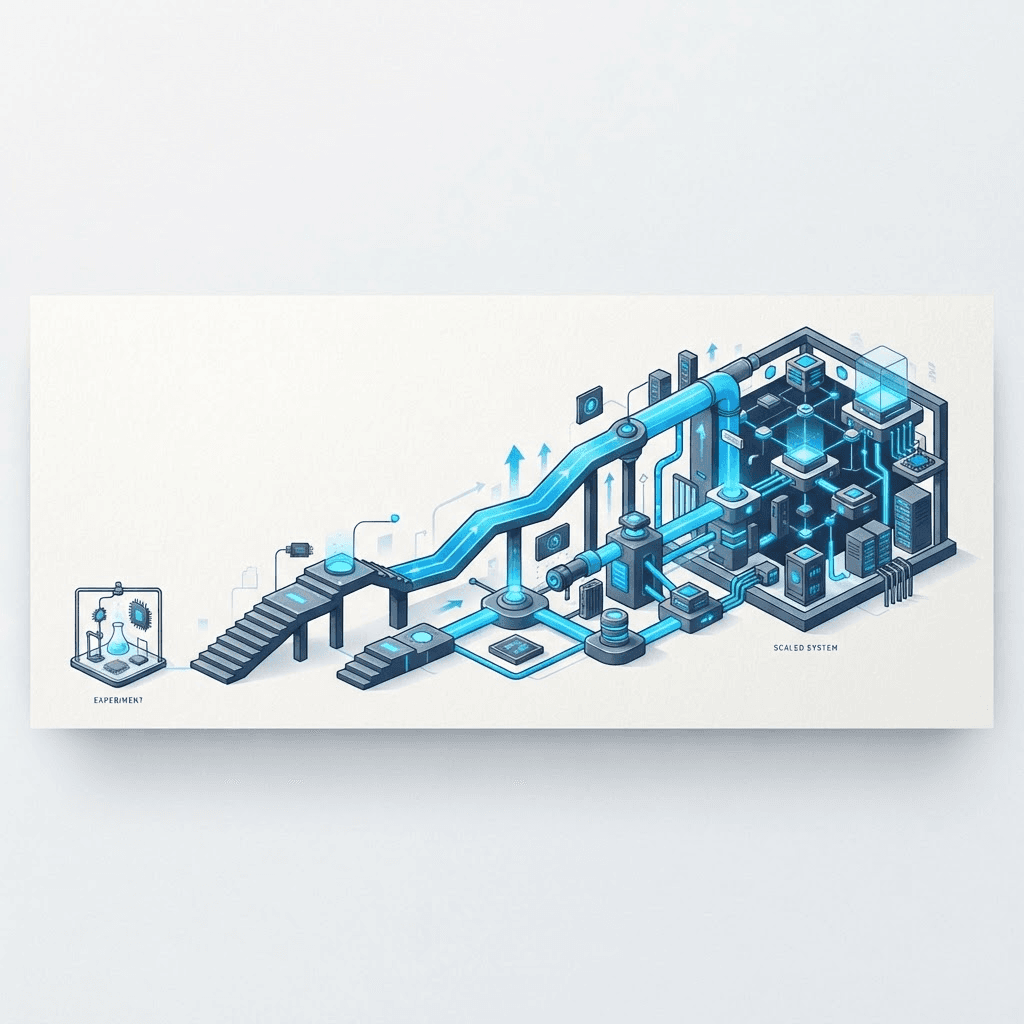
Nearly every organization now has an agentic AI pilot that works. Far fewer have one running in production, handling real volume, tied into real systems, and trusted by real teams. The distance between those two states is where most transformation programs quietly stall. The encouraging news is that the gap is rarely about the model. It is about the operating model around it.
Why Pilots Look Easier Than They Are
A pilot succeeds under generous conditions. The data is curated, the scope is narrow, the users are enthusiastic, and a human is watching every output. Production removes all of those cushions at once. Inputs arrive messy and unexpected, edge cases surface at scale, and the humans who once supervised closely now expect the system to carry the load.
The result is a predictable pattern: a pilot that dazzles in a controlled demo, followed by a stall when the team confronts integration, permissions, monitoring, and the unglamorous work of making the thing dependable. Recognizing this early reframes the goal. The pilot's real job is not to prove the model is clever; it is to expose what production will demand.
Design the Pilot for the Path to Production
The most effective teams treat the pilot as the first increment of the real system, not a throwaay experiment. Concretely, that means using representative data rather than a clean sample, wiring into at least one real system of record, and instrumenting the run with the same observability you will need later. When the pilot already resembles production in structure, scaling becomes an act of hardening rather than rebuilding.
It also means choosing the first use case for its path, not just its appeal. A flashy use case that touches sensitive data and a dozen systems is a poor starting point. A narrower one that delivers clear value through a single well-understood workflow gives you a route you can actually walk, and a win you can build on.
The Operating Model Is the Hard Part
Scaling agentic AI is as much an organizational change as a technical one. Someone has to own the agent in production: monitoring its behavior, triaging failures, and deciding when to expand its authority. Support processes need to account for a system that occasionally needs correction. And the people whose work the agent touches need clarity on what it does, where its boundaries are, and how to escalate when it gets something wrong.
Without this operating model, even a technically sound agent drifts. Prompts and tools change without evaluation, failures go unexamined, and trust erodes with every unexplained mistake. The teams that scale successfully invest in ownership and process with the same seriousness they bring to the model itself.
Measure Value, Not Novelty
Executive patience for AI that is merely interesting is running out. To sustain investment, connect the agent to a metric the business already cares about: hours saved, cycle time reduced, cases resolved without escalation, revenue influenced. Establish the baseline before you deploy so the improvement is undeniable, and report it in the language of the business rather than the language of the model.
This discipline also protects you from scaling the wrong thing. If a pilot cannot show a credible line to measurable value, that is a signal to rework or retire it, not to push it into production and hope.
Scale Deliberately, Then Compound
Crossing from pilot to production is less a leap than a sequence of deliberate steps: harden the pilot, stand up ownership and monitoring, prove value on a narrow workflow, then widen scope as evidence accumulates. Each step de-risks the next, and each success makes the organization more capable of absorbing the one after it.
Handled this way, agentic AI stops being a portfolio of stalled experiments and becomes a compounding capability. The first production agent is the hardest. The discipline you build getting it there is what makes the second, third, and tenth dramatically easier.